
My first month or so running was not particularly eventful, funny, or even interesting. I started on the treadmill three days per week, running a quarter-mile, then walking a half-mile, and over the course of a few weeks, I increased my running distance to one mile while decreasing my walking distance to a quarter-mile. From there, I moved to the indoor track, which somehow managed to be less exciting and more tedious than the treadmill. Once again, incrementally increasing the distance by 10% a week.
For anyone who has never run long distances and intends to, here is my best advice: There are certain jobs which should only be done by professionals. Jobs like surgery, bridge design, bomb defusing, and running shoe selection. For this, I went to Dick Ponds in Hoffman Estates.
The shoe fitting process is not entirely unlike the wand selection process from Harry Potter. You get on a treadmill, and they analyze your gait and select a shoe based on your running style. (Just like Harry Potter.) The first shoe they chose for me was the New Balance 860v9. I would max these shoes out at 300 miles, and they are still my crappy weather shoes. I loved them.
As I mentioned in Chapter Two, I had signed up for a 5k (The Dublindee 5k in East Dundee, Illinois), and had two months to train for it. My original goal was to run the entire 3.1 miles in under 27 minutes, but it was a week before the race, and I had not yet cracked 29 minutes. I tempered my expectations and changed my goal to 29 minutes, so a failure to meet expectations would not defeat me.
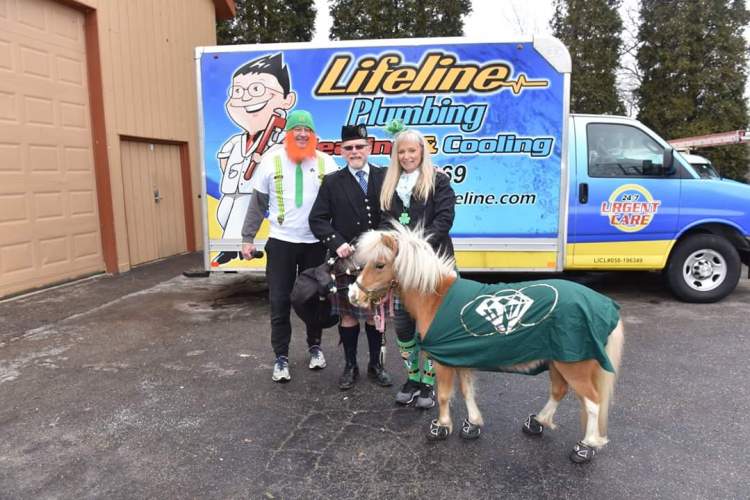
As Joseph Campbell would tell you, every hero’s journey requires a villain, and my villain was waiting for me in Lifeline Plumbing and Heating. As I stretched in the warmth of Lifeline’s garage (the starting point of the Dublindee 5k), I overheard a fellow fun runner talking about how she was worried that she might not finish the race. I was not the only person outside her party to hear her, as a middle-aged man replied to her in an admonishing tone, “If you can’t just wake up and run a 5k, you’re in pretty sad shape.” She was stunned; I was stunned; we were all stunned.
Upon hearing this, my goal was no longer to finish in 29 minutes. My goal was to beat that man.
He started about 10 yards in front of me, but I had passed him within the first quarter-mile, and did not see him again until I was on the “back” half of the “out and back.” I had a substantial lead on him. I crossed the finish line with a time of 26:04. I had crushed my original goal, which I deemed to be unrealistic, by 54 seconds. Unfortunately, I did not see how much I beat my villain by, because I was distracted by a miniature horse.
My runs grew longer and got faster. My Dublindee 5k pace eventually became my long slow distance pace, and my race pace teetered around 7-minute miles.
Every couple of weeks, I would participate in a different 5k.
- Dublindee Kilted 5k: 26.04
- Deer Park St Paddy’s 5k: I don’t remember my time, but this would be my last race over 200 lbs.
- Marklund Run, Rock, and Roll (Bloomingdale):??? / 2nd in age group
- Race To Zero (Libertyville): 24:49
- April Fools 5k (Bloomingdale): 24:27
- Hops For Hope Beer Run (St. Charles) 24:22¹
- Mother’s Day 5k (Barrington): 23:10
- Glo Run (Hoffman Estates): 22:56; 8th overall / 1st in age group
- Lions Heritage (Dundee): 22:13 (This is still my “Old Man” Personal Record. My actual PR is 20:20 which I achieved when I was 15)

By the end of the summer, I weighed 170 lbs, which was the weight that I was hoping to achieve and maintain. This is a net loss of 110 lbs. I was healthier than I had been in over a decade, but something was wrong.
“Cathy, I’m lost […] I’m empty and aching, and I don’t know why.”
Paul Simon, America
I was 16 years old when I realized something was wrong with me. I was almost always sad, but I was able to rationalize this sadness by citing two serious life events (SLEs) that occurred in the latter half of 2003. An entire lifetime later, these events would hardly be considered SLEs, but to a 16-year-old, they were reality shaking.
Unfortunately, as time wore on, this sadness only got worse. I did not want to participate in social events because I had developed the belief that my classmates, friends, family, and society as a whole disliked me, despite all evidence being to the contrary.
One night my mom told me that she had scheduled an appointment for me, to which I replied, “For a psychiatrist?!”
The appointment was for a haircut. I played it off as a joke, but even then (at 16 years old), I knew that I needed help.
I was expending all of my energy by pretending that nothing was wrong, but a person can only do that for so long. In November, I could no longer put on a brave face. Remember that haircut from literally four sentences ago? Well, that turned out to be the straw that broke the camels back. As my mom drove me home from the haircut, I broke down.
I remember sitting at the dinner table, visibly distressed, and my parents asking what was wrong. I had no clue what was wrong with me. As tensions around the table grew (they were under the impression that I was in trouble; to be fair, I was always in trouble), I had to make up some plausible bullshit to placate them. I mentioned the SLEs (from which I was now several months removed) and how my haircut symbolized loss of control. In retrospect, the six years that followed this conversation would have probably been better had I stuck with, “I don’t know what is wrong with me.”
It was during this time that the compulsive behavior that I detailed in the prologue was at its most self-destructive.
In the spring of 2010, I moved back in with my parents, and for only the second time since high school, I went to the doctor. After the nurse checked my blood pressure, pulse, and temperature, she asked me if I ever felt hopeless. I “joked” that I had not felt hopeful since 2003. After a few additional visits and blood tests, I was diagnosed with Major Depressive Disorder (MDD), and things immediately got better for me.
In May of 2019, I went back to the doctor under the guise of knee pain, knowing that they would have to give me another depression screening. When the nurse asked if I ever felt hopeless, I told her in no uncertain terms, “Yes. I feel like nothing I do matters, that I am all alone, and that I am just a bag in the wind being pushed around by forces outside of my control.”
To which the nurse responded, “Oh, ‘a bag in the wind.’ I like that. I’m writing that down.” And once again, things got better, but only for a very short while.
In July, I flew to Portland to visit friends, and I remember saying, “This is the happiest I’ve been in over a decade.” This statement was not hyperbole in any way. If anything, it was an understatement, because this is the truth: I had not felt contentment since either early 2003 or late 2002.
A week later, I saw three nights of Phish, including one of the best concerts I’ve ever attended, and a week after that, I ran a 5k and won my age group for the first time in my life. During these few weeks, I was on record saying, “I feel like I am living someone else’s life.”
These were my salad days.
On September 14th, I, once again, realized that something was wrong. I had just finished my last 5k of “the season” and finished with a time of 22:13. This time was a whole four minutes faster than that of my first race of the year, but I felt no sense of accomplishment and nothing that resembled happiness. At the award ceremony, I had the following text conversation with a friend.
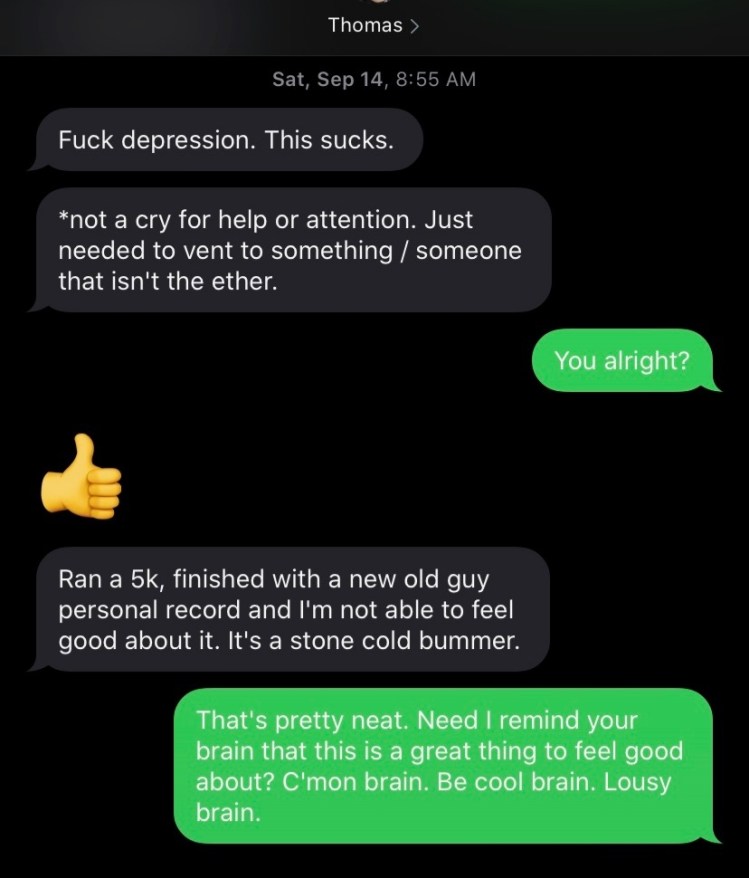
So I went back to my doctor, therapist, and psychiatrist and was diagnosed with something that I had never heard of: Persistent Depressive Disorder (formerly Dysthymia). This new diagnosis did not replace my previous diagnosis of MDD; they are in tandem. This unholy alliance is called “Double Depression,” and it is just a ton of fun. My mental health team then changed my medication, and things got so much worse.
I have always told myself that I am smart enough and strong enough to handle my mental health issues on my own, so I did not keep my friends or family informed about the state of my mental health nor the steps I was taking to get better. This, in retrospect, was dumb.
On the evening of Friday, November 1st, I woke up from what I would describe as an “involuntary floor nap.” It was then that I realized that I needed help badly, so I reached out to three friends with the innocuous text message, “Do you have time to talk?”
After what seemed like an eternity, but was only 15 minutes, my friend Sean called me and listened as I told him I was speaking to him from the gates of hell. He provided a comforting, rational voice, and stayed on the phone with me until he was sure I was not in danger, and that I had my next steps figured out.
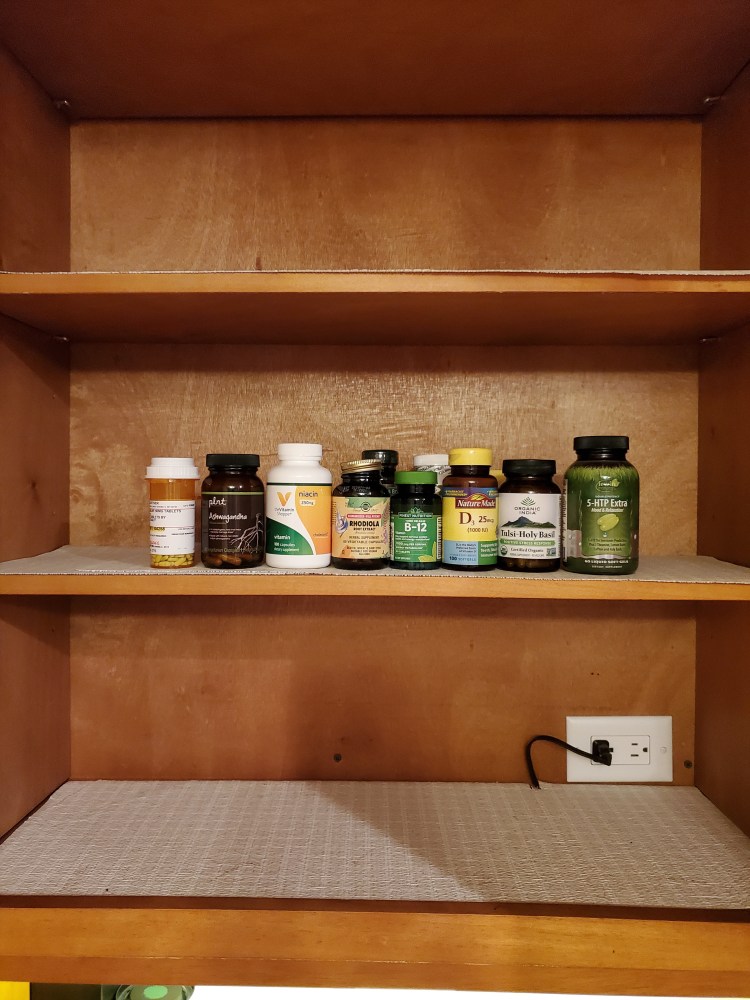
After this episode, I realized that U2 was correct– sometimes you can’t make it on your own. As a result, I made five people to whom I would feel comfortable reaching out, aware of what had happened, and that I needed a plan should there be a next time. This plan included a pretty damn formal document that helps my five-person mental health support team know how to help me when I am in crisis, and a whole mess of holistic remedies that may or may not be snake oil. These remedies include:
- 5-HTP
- Ashwagandha
- B12
- D3
- Niacin
- Rhodiola
- Tulsi-Holy Basil
Additionally, I read Unfuck Your Brain, This is Your Brain on Depression, and How Not To Kill Yourself. Three exceptional, and short, books on depression and recovery. I recommend all three to anyone who is struggling with depression.
As of writing this, I am still not back to “normal,” some days are very challenging. Still, I am determined to get there, and now that I am not facing this alone, I am confident that I will get there.
So yeah…that’s how my first year of running went.
¹ I consumed four beers during this run
$360 Race Fees + $130 Shoes + $150 Misc = $640
Total Spent So Far = $1605
 One Man Wrecking Machine
One thought on “Chapter Four: Run or Die, or, The Lost Hope Diet”