America is at an impasse. We are currently neck-deep in a pandemic and sinking fast, but the only day of the year on which we are legally allowed to show thanks for a bountiful harvest is quickly approaching.
My distaste for Thanksgiving is no secret. Even before COVID-19, I have lobbied for the abolition of Thanksgiving, so call me an opportunist. Still, I believe that now is the perfect time to end this nightmare of a holiday, albeit only temporarily.
Do you know what holidays I love? Memorial Day, Fourth of July, and Labor Day, and an argument could be made that these holidays are pretty much the same. These are all outdoor holidays celebrated with grilled food.
Twenty people outdoors is a party, but twenty people indoors is a loud, anxiety-inducing clusterfuck. (To say nothing about the public health concerns involved.)
Stacking your moderately liberal cousin on top of your conservative uncle who sees politics as binary (Right or Communism) is an awful idea. Unfortunately, late November weather in northern states has been known to prevent outdoor activities. Therefore, the entire gathering gets to hear about why the government should coerce inner-city teenagers into sterilization programs and galaxy-brained hypotheticals such as “what if discrimination is good?”
Throw in the fact that our lamest-of-ducks president is wildly spreading conspiracy theories in a feeble attempt to maintain the power to do nothing about COVID-19 and unquestionably won’t concede by the 26th, and you have yourself a powder keg.
As a nation, we don’t see eye-to-eye right now, and we aren’t going to. We exist on incongruous planes of understanding, and it will take more than a corporate parade and Detroit Lions football to reconcile our differences. Perhaps absence will make the heart grow fonder because awkwardly forced union will surely make the heart grow fungus.
If your argument for why Thanksgiving isn’t the worst day of the year has anything to with the food, I have news for you — you can eat turkey, stuffing, mashed potatoes, green bean casserole, and sweet potatoes with marshmallows as a side — not a dessert —year-round, you just choose not to. Why? Because it is difficult, and the juice isn’t worth the squeeze more than once per year. Brats and hamburgers are easy and good; that is why we have three brat and hamburger holidays. Furthermore, there are no COVID-19 related restrictions prohibiting holiday fare consumption.
I don’t want to sound like I don’t want to give thanks for a bountiful harvest because I am a big fan of agricultural prosperity, and televised parades that showcase cartoon balloons filled with a rapidly depleting non-renewable resource are really my thing. However, it would probably be in our national best interest if we kick this can down the road until there is a vaccine and/or we can congregate outdoors.
If, for some reason, you still feel compelled to give thanks to your friends and family, nothing is stopping you from doing that right now.
People are struggling. Some people are experiencing isolation for the first time. For others, COVID-19 has exacerbated the isolation they already experience daily. People have lost their jobs, and they have lost their loved ones. It was not the masks nor the restrictions that caused the loneliness and loss. It was the COVID-19, and the longer it goes uncontrolled, the longer loneliness and loss will be common symptoms of American life.
Finally, the holidays are always a tough time, especially for those struggling with their mental health. COVID-19, isolation, and layoffs have put this holiday season on a pretty tragic trajectory. If you find yourself struggling with depression, seek help from a mental health professional, and lean into your friends and family. They want to help you. If you have thoughts of self-harm, call 1-800-273-8255 or 911 and know that feelings of hopelessness are temporary.
I am going to die. This is not hyperbole. I doubt it will be today, and it probably won’t be tomorrow, but someday I will die, and so will you. I am so sorry.
I understand the words – I am going to die – and I even accept the reality, but when I try to imagine it, my entire consciousness recoils in abject terror. No matter how I rationalize it, the truth remains — I don’t want to die.
I try not to think about it, but it is seldom voluntary. There are just so many reminders. For example, I was in a truck with one of my closest friends (who will be called “Alex” hereafter). It was 5:30 am, and we were on our way to the Fox River for a 10-mile kayaking trip. I mentioned how bad the Cubs bullpen was (they were garbage), and Alex’s response was, “What else is new?”
Years ago, I visited my grandparents in Downstate Illinois, when my grandfather, a life long Cubs fan, asked how the Cubs were doing. I said, “They kind of suck right now.”
His response was, “What else is new?”
That was our relationship. When we got together, we talked about the Cubs. At the time, I thought of it as just a shared interest, but now that I am older, I know that was his way of staying connected with me. That was also the last conversation we ever had.
In the passenger seat of Alex’s truck, I am thinking about my grandfather, how I haven’t seen him in over a decade, and how someday I too will die.
Alex and I had been talking about this trip for years. (Being completely honest, the version of me referred to as “Big Tom” would have never been able to make the trip.) The original plan was to kayak the 15 miles between West Dundee and St Charles, but the river was low, and there was minimal current, so Alex called an audible. We launched from downtown Elgin.
Elgin is a tranquil town at 6:00 am on a Sunday. The banks of the river hosted a smattering of men and women who fished soundlessly, motionless commuter trains hissed in preparation for their morning trips into the city, and with the exception of the occasional fish leaping out of the water to feast on an unsuspecting insect, the river remained silent and still – neither helping nor impeding our journey.
The further downriver I traveled, the more confident I became, and as we passed the riverboat casino, I turned to see it from a previously unseen angle, and my kayak began to rock.
The grass was greener The light was brighter The taste was sweeter The nights of wonder With friends surrounded The dawn mist glowing The water flowing The endless river … forever and ever
Pink Floyd (High Hopes)
Near the end of my second semester of college, a good friend and drinking buddy asked if I would be interested in buying any of his albums. I gave him five dollars in exchange for “Bridge Over Troubled Water” and “The Velvet Underground,” and Alex bought a Led Zeppelin DVD from him. Shortly thereafter, I saw him snort a line of black pepper for cash. He was clearly in need of money.
He did not return to school in the fall. His girlfriend told me, in confidence, that he was in rehab. Once he got out, we started hanging out again, but in controlled situations. We would watch football games or movies at his parents’ house, and there was never any alcohol — until there was.
The last time I saw him was at my parents’ house for a Milk Days¹ party I had thrown. He died in the spring of 2013. I will likely never know what happened, but I can make an educated guess.
When I was in my late teens and early twenties, I didn’t know what it meant to be an enabler, but now I do, and I won’t make that mistake again.
I turned back downriver, focusing on where I was in that moment and paying no attention who where I had been. My kayak stopped rocking.
Not far from the riverboat, there is a train bridge that is under construction. In order to get cranes and other pieces of heavy machinery into the middle of the river, a temporary jetty was constructed. The jetty funnels the current into a 5-meter wide opening. Being a novice (at best), I insisted that Alex pass through first to see the path I would have to take. The current sent him right into the column of the bridge — his advice: take it wide.
In retrospect, it was cute that I thought I would have any control of my heading. I took it wide, but the current swept me sideways. I nearly hit the jetty and did hit the column. If ever I was going to drown, a possibility which I spent the previous week joking about, to the disgust of many, it was going to be here. I pushed myself away from the column and back into open water. Once again, the current died.
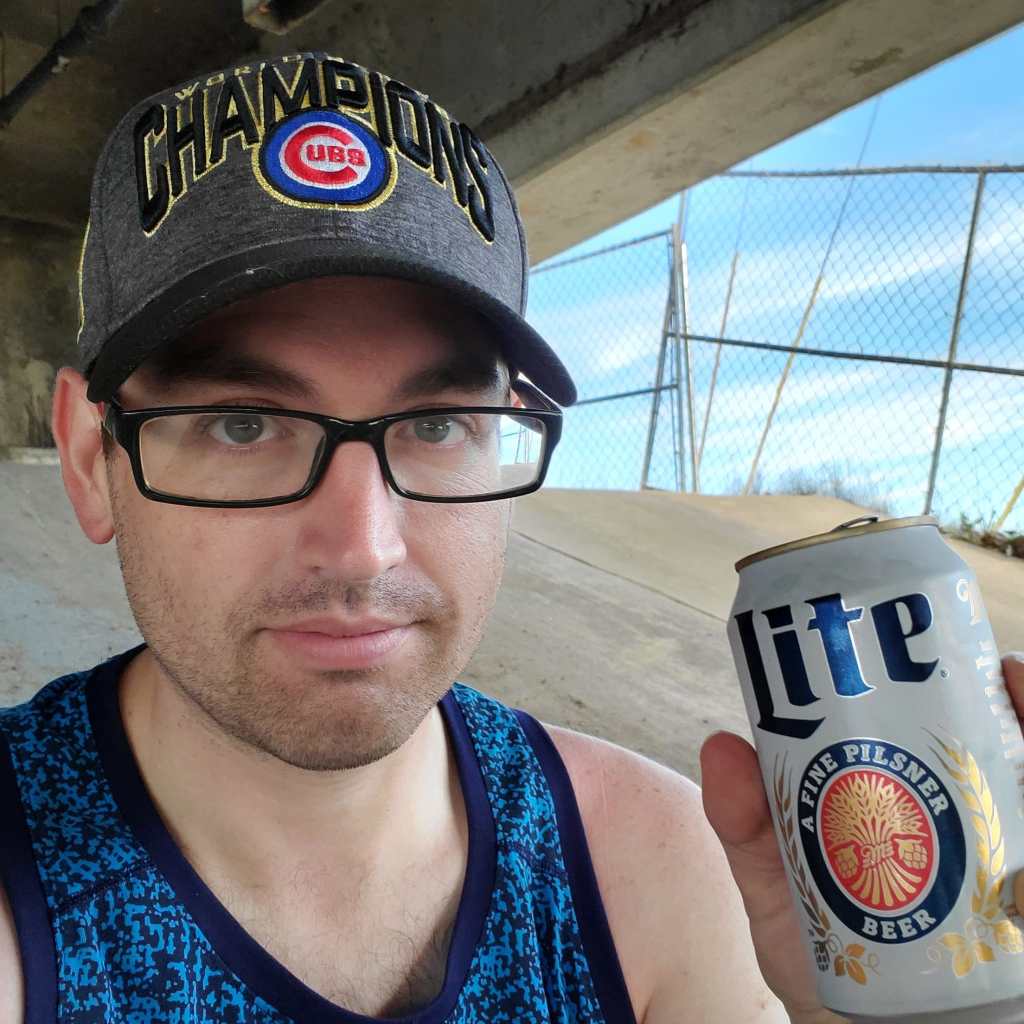
At 7:30, we had to portage just north of the South Elgin dam, which allowed me to have my breakfast (a Clif Bar, Jack Links Teriyaki Beef Jerky, and a Miller Lite) while hanging out in the shade under a bridge. Life is only as weird as you make it.
Pictured Above: A Degenerate
Back on the river, we passed wading Great Blue Herons, as Kingfishers and a Bald Eagle flew overhead. The Fox River is a great locale for bird watching, which is a great hobby that I encourage everyone to pursue, full-throatedly.
The river to the ocean goes
A fortune for the undertow
None of this is going my way
REM (Find The River)
We ground to a halt, as we both bottomed out. Alex was able to find a path that allowed him to make it through with considerable effort, but the route I took required me to get out and drag my kayak for about 30 meters. This would be our only natural obstacle along the way.
As we weaved around the islands near Jon Duerr Forest Preserve, the site of a memorial for the unknown soldiers who died in the Black Hawk War, I sliced my hand on the side of the kayak. Neither of us had the foresight to bring a first aid kit. The rest of the trip, I focused on keeping my hand out of the disgusting river.
We stopped on the eastern bank near Valley View so I could clean my wound and wrap my hand in the boxing wraps, which I don’t know why I brought. I also enjoyed a second Clif Bar and re-hydrated with the great taste of an ice-cold Miller Lite, which did not make me logy due to its less filling nature. The four miles that followed this stop were the most tedious of the trip, as the current completely disappeared. It was at this point in the journey we faced our third and final obstacle — assholes.
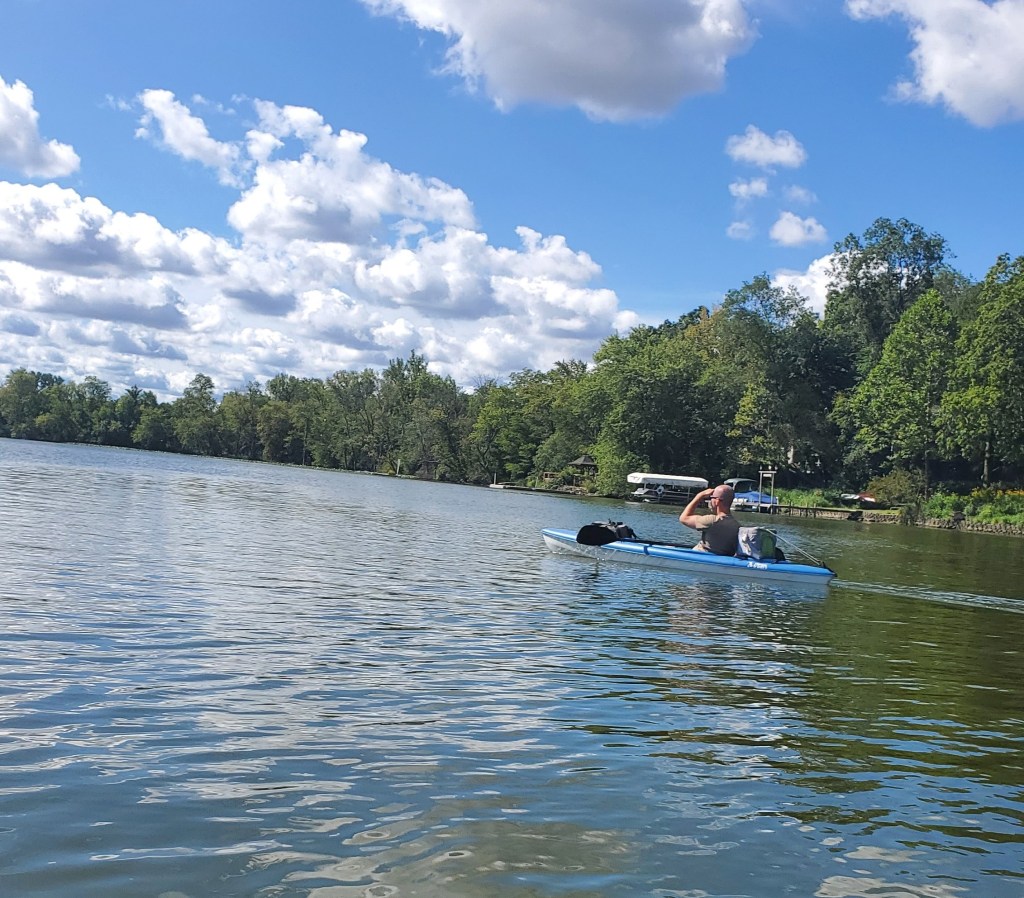
Alex on the river
We had been lucky that the only motorized watercraft we had encountered thus far were trolling pontoon boats, but in the lake-like waters north of St Charles, the powerboats and jet-skis showed up in force. The first time I had to reckon with the wake created by one of these crafts, I thought it was fun, but each time they sped by, it became considerably less fun.
Most of them did give us a wide berth, but there was this one who could not have cared less that there were kayaks on the river. Each time I would hear a loud motor coming up behind us, I would turn to see who it was, and each time, I would rock.
Dear God, be good to me. The sea is so wide and my boat is so small.
Breton Fisherman’s Prayer
In the fall of 2008, a friend of Alex and mine who had dropped out of college after our freshman year visited me at my apartment. For the occasion, my roommates and I threw a party. It was here that he informed me that he had enlisted in the Marines.
He behaved kind of oddly at the party. He at some spaghetti out of our fridge and drank a glass of milk. I don’t know why, but both of these things stuck with me. The next morning, I offered to take him to breakfast, knowing that we would not see each other for a while.
At breakfast, he told my roommates and me an incredibly anti-climatic story. It was long, it meandered, and it completely fizzled out, but he was excited as hell to tell us this story. This story would be how some of my roommates remembered him and would become a running joke in our apartment.
That was the last time I ever saw him. He died in the spring of 2013, but I didn’t know until the spring of 2015. Unlike our other friend, we know exactly how he died. It was a national news story.² To this day, I feel like a shitty friend every time I think about him. I sincerely wish I hadn’t made him the butt of a running joke, and how does one go TWO YEARS without knowing that a friend had died and still have the audacity to call that person a friend? Because of this, I try not to make mean spirited jokes, and I regularly tell my friends that I love them, which makes some of them profoundly uncomfortable.
Eventually, we made it to the no-wake zone, where I no longer had to look back upriver and risk tipping. This trip confirmed something that I had already known: Every time I look back, I risk drowning.
The river flat-out refused to aid us in our expedition. We toiled for the last couple of miles. A flute played in the distance, or perhaps it was a siren trying to lure me onto the rocks, oblivious to the fact that I am not a sailor, but rather the waves which will always end up on the rocks, without fail. Most likely, though, it was someone playing the flute.
We finally reached the point where we would disembark and pulled the kayaks ashore. In doing so, my sandal fell off my foot, which I promptly sliced open on jagged rocks. Tired, sore, bleeding pretty severely from my foot, and celebrating our successful journey with the crisp, refreshing taste of Miller Lite, we walked the half-mile from the river to Alex’s house, where I dressed my various wounds.
The river continued towards its terminus without us, but I try not to think about that.
St Charles in the distance
¹ Since 1942, Harvard, Illinois has hosted an annual festival called “Milk Days” to honor those who provided milk to the war efforts.
On one of my many bike rides along the Fox River, I nearly leapt off my seat at the sight of a Baltimore Oriole (the bird). Since a prerequisite for nostalgia is a fondness for the past, there are very few things that elicit such feelings within me. Baltimore Orioles, I found out at this very moment, are among those few things.
On the first day of my first year of competitive baseball, I met a kid who would eventually become my classmate, bandmate, roommate, shoulder-devil, and de facto / pro bono psychologist. We were the two shrimpiest kids on the team — the Orioles. Few (if any) have made as profound an impact on my life as this friend. As a result, apparently, I now associate Orioles (the bird) with a pleasant childhood memory.
After my bike ride, I researched orioles and found that they are mostly encountered high in trees in semi-wooded wetlands and along rivers. Upon learning this, my brain went into full-on nerd mode, researching birds at a furious pace to discover what other birds I could expect to see on my rides. My biggest take away was this: birds are fantastic. So I drove to the bookstore intent on buying a book on birds of the Great Lakes Region, but as I weighed my options, it dawned on me that I was dangerously close to becoming a birder.
[I acknowledge that I might have just alienated some of my audience, so I would like to state in no uncertain terms that I do not believe there is a single thing wrong with bird-watching. I genuinely get the appeal.]
As a single guy in his early thirties, who already followed Phish, obsessively watched Star Trek, and would prefer to read than socialize most of the time, I was already quirky enough (and that doesn’t even factor in my sense of humor, minimalist lifestyle, or ludicrous car). I could not in good conscience add bird-watching to that list. I felt it would tip me over the edge from “idiosyncratic” into “The Realm of The Completely Undateable.” Also, I don’t think any single guy should own a pair of binoculars.
How can I convince you it’s me I don’t like?
Wilco (Reservations)
By this point, I had already made a commitment to changing my life dramatically. Still, the only real changes I had made were related to losing weight, which was not my only goal. I did not like who I was. I wanted to be a completely different person. If I was Ziggy Stardust before Labor Day of 2018, I wanted to be Halloween Jack by the summer of 2019.¹
Some things were easy to change. As I donated bag after bag of XXL shirts and 38″ waist pants to Goodwill, I had to replace those items with clothes that fit. This allowed me to change my wardrobe completely (twice over). Tee shirts with Calvin and Hobbes or Saru, the gangly alien from Star Trek, were replaced by collared shirts or single-color tees.
I also ditched my beard. Honestly, the beard was not a great look. It grows patchy on my cheeks, so I have to style it like Toby Ziegler from The West Wing, and it doesn’t know what color it wants to be. The dominant color is “Cheetos dust orange,” but there are enough brown and white hairs to make it resemble a mosaic of a Cleveland Browns game. It was more utilitarian than anything, being used to hide my chins.
For those of you wondering what my beard looks like.
I even switched to contacts², which was difficult because, as anybody who wears glasses knows, glasses are more of a lifestyle than a fashion choice. This caused my personality to decrease by 20%.
On top of changing my appearance, I changed the appearance of my apartment by taking down my more cartoonish concert prints and boxing up my fleet of miniature starships. I bought a box spring and a nightstand and a first aid kit. A lava lamp was donated. Before making these changes, I was a string of Christmas lights away from living in a dorm room.
I was no longer satisfied with the rut that I had fallen into regarding music. My tastes had not evolved since college, so I challenged myself to listen to and appreciate music written in the last decade. As a result, Vampire Weekend’s “Father of the Bride” became the soundtrack to my 2019.
When my Xbox died, I did not repair nor replace it —I simply donated my games to Goodwill (not that I was much of a gamer before; this was more of a symbolic gesture). I canceled all my streaming subscriptions (excluding Spotify) and reallocated the time that I would usually spend watching TV to other things like running, riding my bike, or cooking healthy meals.
The only things that I didn’t change during this time were my friends, job, name, and literary tastes. Everything else was on the table.
Change is scary. If a person is comfortable, even a small change represents a threat to that comfort. This is “If it ain’t’ broke, don’t fix it” mentality. At the same time, if a person is not comfortable, there are no guarantees that change will not make matters worse.
It is even scarier when we are told that we have to make a change because that forces us to acknowledge something that we might not want to — something is wrong.
For me, it was evident that something was wrong. No one had to tell me what I already knew. So I made one change; I stopped eating fast food. From there, I started exercising a few times a week, then every day but Sunday. I tried yoga, boxing, CrossFit, and tennis, and all of this was catalyzed by one small change.
The amazing thing was that after each change, the next became easier and more ambitious. What started out as a seemingly ineffectual ripple became a tsunami.
Seeing each change affect me for the better, allayed any fear of change I had, and I became adaptable. Adaptability was a trait that I sorely lacked. My inability to adapt led to anxiety and occasionally anger towards my friends and family who would alter plans with or without notice.
Change is scary if you aren’t used to it, and the status quo is comfortable until it isn’t. The thing is, we do not have to wait until a situation becomes untenable for us to make changes. One little change can lead to amazing things, and you might find, as I did, the more frequently you leave your comfort zone, the less you desire to return.
¹ David Bowie performed as a character named Ziggy Stardust from 1971 to 1973. When he felt like this character was bleeding into his actual personality, he retired it. In 1974 he performed as a character called Halloween Jack.
² I have temporarily switched back to glasses because I don’t want to touch my eyes due to Coronavirus.
After the buzzer sounded and her shot fell through the net, Morgan William was mobbed by her Mississippi State teammates. All the opposing coach could do was smile as he watched the celebration in defeat. A two seed defeating a one seed in the semifinals of a college basketball tournament is not an uncommon feat, so why was this particularly stunning? It’s because this particular upset ended what is probably the most dominant stretch in the history of American sports. The team Mississippi State beat to move on to the NCAA finals was UConn – a team that had won 111 consecutive games. That streak was 21 games longer than the second-longest win streak, which also belonged to UConn. A week later (April 2, 2017), when Mississippi State hoisted the championship trophy, they became the first school not named UConn to do so in five years.
Speaking of 2017 — In 2017 the Clevland Indians, only ten months removed from garnering the unfortunate distinction of being the team that ended the longest futility streak in American sports history (the 108 years the Chicago Cubs went without winning a World Series), won 22 consecutive games, an AL record.
Baseball, being a game of history and an ingrained part of America’s shared heritage, glorifies streaks more than any other sport. Fans wax nostalgic about when Cal Ripken Jr. broke Lou Gerhig’s streak of consecutive games played (2130) in 1995. Ripken went on to play in 2632 consecutive games.
As impressive as Ripkin’s streak is, one can hardly discuss famous baseball streaks without mentioning the game’s single most revered streak: Joe Dimaggio’s 56 consecutive games with a hit. No player before or since has come within ten games of this record, and only two players in the last 100 years have come within 15 games – Pete Rose (44 games in 1978) and George Sisler (41 games in 1922).
So why do we love streaks so much?
Probably because we all love greatness, and the only thing greater than greatness is sustained greatness. None of these streaks were achieved by just being great, just being lucky, or just showing up every day. It is a combination of the three. All of these streaks required years of hard work that the spectator will never see; they required an unflagging determination to be the best – every day- when most of us get too mentally fatigued to wash our hands regularly during a pandemic; and they required the wings of a distant butterfly to flap at beneficial intervals.
Every time one fails to extend a streak, the counter resets to zero. All it takes is one bad bounce, blown call, or injury, and you are suddenly Sisyphus at the bottom of the hill. Unlike Sisyphus, we are mortal, and our athletic primes are minuscule segments along the line that is eternity. So when Sisyphus will restart his ascent, we can only look at the mountain and then the boulder, and hang our heads.
Just before Memorial Day, a member of my running club for Phish fans challenged the group to a Memorial Day to Independence Day run streak. The only rule was that you had to run at least one mile every day for the 40 days between Memorial Day and the 4th of July. Easy peasy lemon squeezy. I did not hesitate to accept this challenge.
Stage One: Denial
It was about a week into the challenge when I had a conversation with one of my myriad accountability partners in which I suggested that I might try to blow the doors off the 40-day challenge and shoot for 56 days as an homage to Joe Dimaggio.
To celebrate my first 7-day run streak since high school, I ran a 5-kilometer run at race pace. This was arrogance. I only had to run one mile to extend the streak. I was going for triples when all I needed was a base hit.
Stage Two: Anger
On day 12, I ran a D-Day 10k. My time was only ten seconds faster than my previous 10k, nearly one month earlier. I was running more, but I was not giving my body time to recover, so my times were suffering. When I expressed disappointment in my lack of progress, a friend helped me put it in perspective by reminding me that it was, “Better than ten seconds slower.”
On top of general fatigue, I was developing shin splints, so my mile “preservation” runs were roughly one minute slower than my typical mile. Needless to say, I was frustrated, and only two weeks into the challenge, I started thinking that I would not make it to 40 days, let alone 56.
Stage Three: Depression
I was fatigued, I was in pain, and I wasn’t going to get better until the challenge was over. It was 25 days into the challenge that I realized that my mile-long preservation runs were not long enough to be considered a full cardio workout, so, in a sense, what I was doing was counterproductive to my fitness goals.
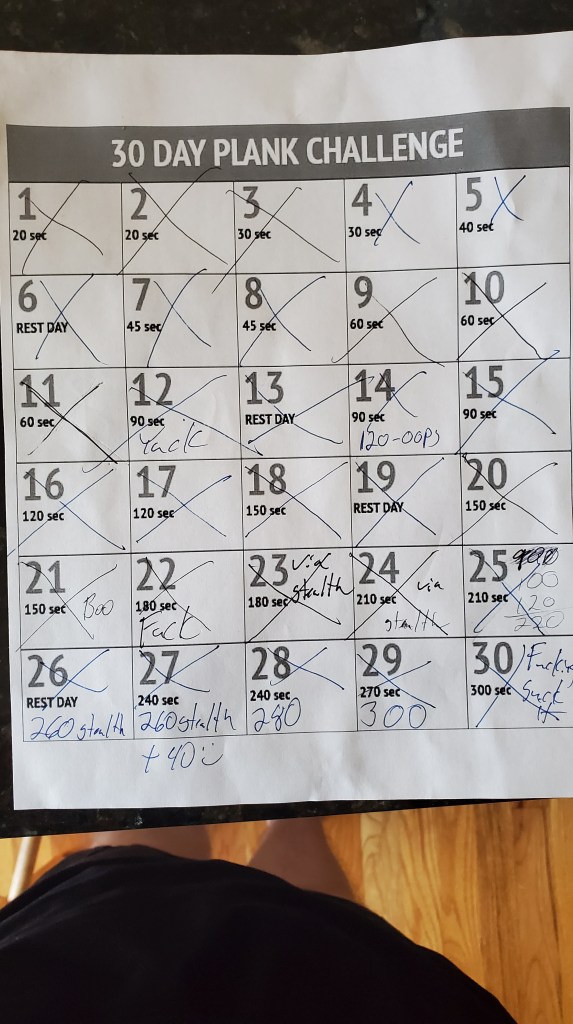
I had already added a plank regimen to my routine (30 Day Plank Challenge), but even that wasn’t enough.
Adding a second challenge, because life is pain
Stage Four: Bargaining
Me: Alright, Tom. Time to run. Also Me: I don’t wanna. Me: If you run just one mile, we will go to Starbucks for a nitro cold brew. Also Me: With honey and sea salt? Me: Let’s see how our run goes, and if I feel like we earned honey and sea salt, we can get it, but if we are dogging it out there, we’ll only get the cold brew.
We earned the Honey and Sea Salt
I had to make this deal four times during the 40-day challenge.
Stage Four and a Half: Wait…did I do the math wrong?!
This was a 40-day challenge, but after my run on day 37, I realized that I still had four days left until the 4th. A quick Google search confirmed that it was 40 days from May 25 until July 4, but how could that be? After counting each square on my calendar, my suspicions were confirmed — it was a 41-day challenge.
There are days and there are days and there are days between
Stage Five: Acceptance
Exhausted, sore, sunburned, and under-motivated, I resigned to coast through the last week of the challenge by only running one mile per day, and my stretch goal of 56 days was out of the question. If I hurt myself and had to rest for an extended period of time, this whole thing would have been a detriment to my fitness. This might be considered “playing not to lose” rather than “playing to win,” but it was the smart thing to do.
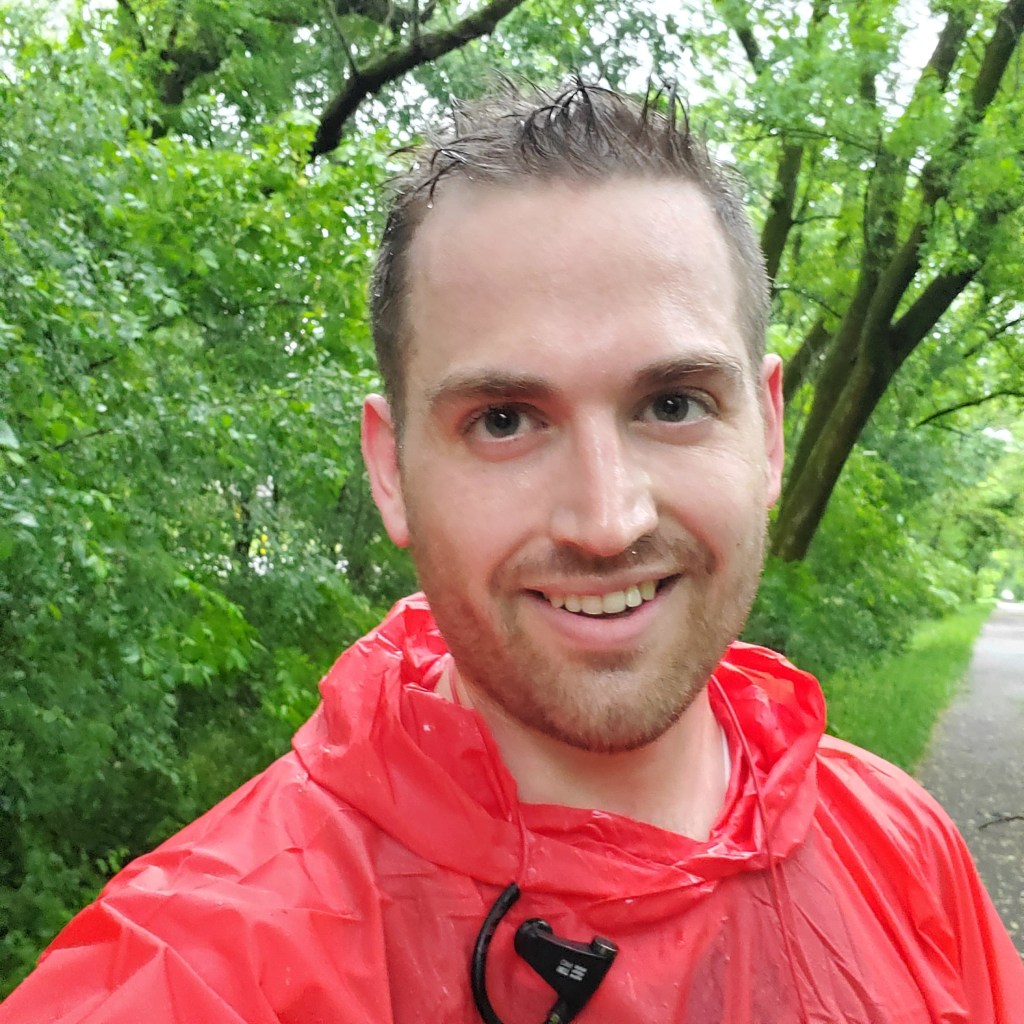
Sometimes I would have to run before work; other times, I would run well after the sun went down. Sometimes I was wearing a poncho; other times, I was wearing short shorts, also known as “ranger panties” (mostly after the sun went down). Most of the time, I was sober, but one time I wasn’t (that wasn’t very smart, and I will be the first to admit it).
At the end of 41 consecutive days, I had logged 88 miles without any real injuries, which is a win in my book. I would not have participated in this challenge had it not been for my friends, and if I had, I probably wouldn’t have finished without them spurring me on. Tomorrow my boulder will roll to the bottom of the hill, and I do not intend to chase it.
It is amazing how our perceptions of birthdays change as we age.
When you were young, it was the one day of the year on which the Earth revolved around you. Your friends and family sing songs in your honor, shower you with presents, and serve you your favorite food — sugar. It was your favorite day, and you looked forward to it year-round.
As a teenager, you were probably too cool to hang out with your family on your birthday. The expectation of gifts and cake still existed, because it was still your day, but the list of people you want to share your day with was culled, dramatically.
In your twenties, the gifts mostly disappear, but your friends and the family you want to see celebrate with you by allowing you to get absolutely wrecked without judgment. This might continue beyond your twenties.
To some, it becomes just another day, while others expect the Earth to revolve around them for that one day for his or her entire life. For most of us though, how we celebrate birthdays evolves as we do.
Last year, on my 32nd birthday, I decided to celebrate it in a way that I had never celebrated anything before, by taking a long bike ride.
As you may recall from Chapter One, my goal in my first year of cycling was to ride my bike from West Dundee, Illinois to St. Charles, Illinois and back, but my efforts were thwarted by an injury that required me to take a break from riding. That was my goal for this ride. I was going to finally achieve it by riding to Mount Saint Mary Park, eating lunch in the park, and then riding home, and I made it to the park…and it was easy as hell.
Ten months removed from my painful, four-mile birth into cycling, I had ridden half of my planned 30-mile trip with ease. So instead of stopping there, I kept on heading south along the river to Geneva. When I got to this tranquil little island park (which is appropriately named “Island Park”), I stopped and ate my lunch (a couple of granola bars), took an embarrassing selfie (not pictured), and rode home. In all, it was 34 miles, and it was the longest bike ride of my life.
Island Park – Geneva, Illinois.
The next day, I drove to the spot where I had turned around and continued south to Batavia, but this time I was running.
This year I did pretty much the same thing. I prepped with a juice cleanse for the three days prior (more on that eventually), and on my birthday itself, I ran 1.3 miles to maintain my 23-day run streak (more on that eventually) and then headed out on the trail on my bike. This time instead of riding to Geneva, I rode to West Chicago and back.
So why am I celebrating with hours of exercise instead of getting blotto?
In previous years, when I would raise a glass, I was not raising it to “another year.” I was raising it to numb the pain (as described in Prologue and Chapter 4). Not only is that no longer necessary, but it is incongruous with how I want my life to be.
I am no longer celebrating my birth; I am celebrating my rebirth. (Forgive my melodrama, but I cannot resist parallelism.) I am celebrating my health – both physical and mental. Mostly I am celebrating that life is staggeringly improbable, and even though it is ultimately unpredictable, the profound changes I have made over the last couple of years potentially have allowed me to ride just a little bit longer.
When future generations ask, “How did civilization collapse?” I will paraphrase Hemmingway by saying, “Two ways. Foolishly at first, and then idiotically.”
What started with exceptionalism, denial, and petty bickering quickly devolved into toilet paper hoarding, more denial, profiteering, and finger-pointing. After the governors closed non-essential businesses, we did what has sadly become expected in our country — we became tribalistic during a time that demanded pluralism. Suddenly we had our factions: lives vs. livelihoods.
“E Pluribus Unum” is surely an ironic motto to inscribe on the currency of this Utopia gone bust, for every grotesquely rich American represents property, privileges, and pleasures that have been denied the many. An even more instructive motto […] might be: Grab much too much, or you’ll get nothing at all.
Kurt Vonnegut (God Bless You, Mr Rosewater)
We saw mass graves; armed protests and masked counter-protests; politicians suggesting that the older generations sacrifice themselves for the good of the economy; rent strikes; conspiracy theories about 1) public health officials being in cahoots with vaccine producers and/or China, 2) state governments lying about death tolls in order to stoke the flames of fear or to scam the federal government, and 3) governors using the pandemic to institute a de facto state of martial law for nefarious reasons yet unknown; people murdering people over their right to shop without wearing a mask; record unemployment; and, of course, roughly 80,000 Americans dead over two months. Ashes to ashes, we all fall down.
The idiom “off the rails” naturally evokes images of a derailed train, but when a train derails, its path of destruction is reasonably predictable. Our current situation is not predictable at all. We don’t know which direction our disaster will go, or whether it will slow or accelerate. This is less a train run off the rails, and more a rocket sled.
A friend of mine recently resigned to the belief that nothing matters anymore, and I would be lying if I said there were not times that I agreed.
In an age where we can exclusively watch the news with which we agree, isolation has fortified all of our bubbles. Unknowns are known, facts are lies, community is dead, and the America that my parents and grandparents believed in likely never existed at all. Eat at Arby’s.
All of this is to say, maybe my half marathon being canceled is not that big of a deal, and neither is the fact that my gym, yoga studio, and tennis club are all closed.
While one may encounter many defeats, one must not be defeated.
Maya Angelou
On February 29th, I went for a 10-mile run. At this point, not only was I confident that I could finish a 13.1 miles race, but I was also starting to think that I could do it in under two hours. On Mondays, I was practicing yoga, Tuesdays were for speed work, Wednesdays were a rest day, Thursdays were tempo runs, Fridays I cross-trained, Saturdays were for long slow runs, and on the seventh day I played tennis. I went into March with a renewed zeal and a full head of steam, but a chainsaw suddenly and mercilessly severed that head.
With my yoga studio being closed, in-person classes became zoom classes. This works for a workout, but it does not have the same calming effect a traditional class has, because I can hear my neighbors yelling and playing loud music. With my gym being closed, cross-training became tedious, prison-style workouts. My days had the sickening monotony of a suburban subdivision.
Meanwhile, the media (both traditional and social) had convinced me that supporting local restaurants was my civic duty, while I conveniently forgot that most restaurants serve salads. The only way I acquiesced to the nagging voice in the back of my head telling me to eat “healthy” was by drawing a line in the sand at red meat. No burgers, but Cuban sandwiches and fried chicken were still fair game. Never again will I underestimate the power of a good rationalization.
Most damaging of all was the fact that I was no longer training for something specific. From the onset, I believed that there would not be any races in 2020. Why would I go out and run in the snow or freezing rain if I was not training for something? When I consulted the “Tom Iftner Manual for Living with Defeat,” I could only find the first edition. So in mid-March, I gave up. I traded in my running shoes for a cocktail shaker and intended to wait out the pandemic reading about iconic or controversial sports figures¹ and rocking a buzz.
To recap: decreased exercise, increased alcohol consumption, and semi-weekly “bar food” indulgences. One does not need a medical degree to know what was coming. I had put on the “quarantine fifteen.”
Above: The asshole who deserves the blame for all of my problems
I had noticed that my shirts were a bit tighter – not to the point of having to purchase new clothes, but undeniably snug. It was not until a coworker gasped and said, “You got fat” that I realized just how much I had let myself go. Though, for the record, I do feel that “fat” might be overstating things a bit. “Doughy” would be a more appropriate descriptor. Nevertheless, he was right(ish), and I knew (once again) that I had to make a change.
It was evident that I had lost ground. After one particularly disheartening workout, I had expressed my displeasure with myself via text, using words like livid, complacent, and “ducking” (obviously unintentionally), so we set up a virtual run. My friend dubbed it: Uncle Momar’s Race for the Cure. It was a 10k set to be run on May 16th.
[Since writing the bulk of this chapter, Uncle Momar’s Race for the Cure has been run. I won on a technicality, which as we all know is the best way to win, when my rival failed to follow the only rule — run 10 kilometers — and stopped after only 9.86 kilometers. The rematch of the century is set for June 6th.]
Additionally, I had another friend who had curated a ragtag team of Phish fans and set up themed virtual runs. We had an April Fools, 4/20, and Cinco De Mayo 5ks. Unfortunately, I was unable to finish the 4/20 5k because something was off. My pace was terrible, and my knee felt “wonky.” I shut it down after a mile and a half. Queue the aforementioned “Ducking livid” rant. Despite my poor showing and frustration, I was able to take away something positive from this experience, and that was the knowledge that community is not dead.
Now that I had something for which to train and accountability partners, things were looking up, but it was still mid-spring, and my gym was still closed. My workout regimen was at the mercy of the Tempestates. There is some satisfaction to be found running in drizzle or the snow, but freezing rain is miserable, and it stymied my efforts more than once, but I adapted, and I persevered.
This brings me back to my occasional dalliances with nihilism. If nothing matters, why am I doing this? Giving up would be easier, understandable, and, frankly, on-brand.
It could be a futile act of rebellion against the absurdity of our current situation. It could be my lizard brain desperate to survive. Or maybe I’m just a cockeyed optimist. As plausible as two of these possibilities are, I think the most likely reason is this: I am doing this because it matters to me, and that is good enough.
After I published the chapter in which I discuss my struggles with depression, several people reached out asking for advice. The advice that I give (aside from seeking help from a mental health professional) is largely applicable to our current situation — the sense that nothing matters is temporary, and don’t think you have to go it alone.
Stay healthy, be kind, don’t eat at Arby’s, and please – wear a ducking mask.
¹ I highly recommend Snake: The Legendary Life of Ken Stabler [Mike Freeman] and Off Base: Confessions of a Thief [Rickey Henderson and John Shea.]
When I was very little, I participated in junior tackle football. I was one of the three smallest kids on the team, and I was just awful. I never blocked, and I ran the ball precisely three times in my first season. I quit after my second season but rejoined the team when I caught up with the rest of my class in size. By the end of this season, I asked the coach to stop calling plays that required me to run the ball because I was tired of getting tackled.
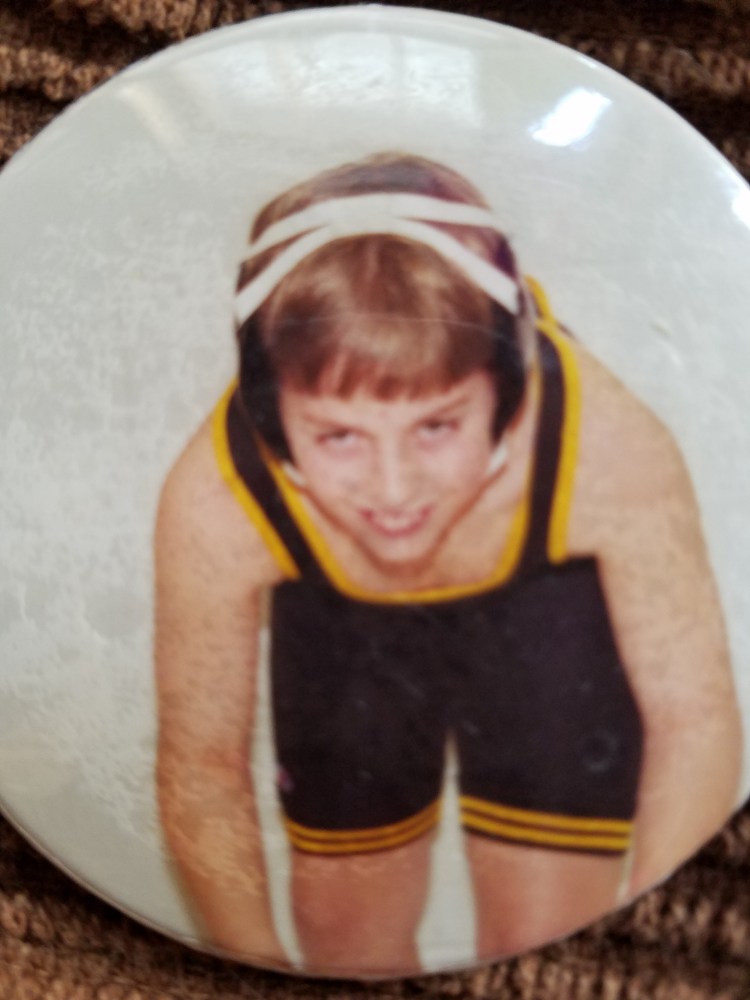
In junior high, I joined the wrestling team, and I was somehow worse at that than I was at football. I never won a single match, all but one match was over within the first 30 seconds, and there would be no second season.
Pictured above: “Wrestler”
The next year, I joined the basketball team, and I was awful. I was the second-string point guard on the B-Team. At the conclusion of the season, I had more ejections (1) than points (0). The highlight of my time in basketball was when I ran through a moving screen and put the opposing player on his ass. Not being good at basketball was a tough pill to swallow because I love basketball, but by the time I was in high school, I knew there was no point in trying to pursue it.
All of this is to say, when I was young, I learned that not every activity was for me.
For good measure, here is a list of other things that I suck at:
Drums
First Person Shooters
Anything That Could Be Considered Visual Art
Spelling “Definitely” Correctly On My First Try
Water Skiing
Disney Trivia (Sorry Team)
Having tried my hand at running, biking, boxing, and yoga, and really enjoying each of them, I began calling myself a “devout amateur” or a “fitness dilettante.” I was willing to dabble in anything, without any commitment to any one activity. So when I got an email from a cross-fit gym near me about a free trial week, I jumped at the offer.
The first class was great. The guy who ran it was surprisingly laid back. I say “surprisingly” because my preconceived notion about cross-fit was that everyone who participates in cross-fit is either Type-A, an adrenaline junkie, or a meathead. The workout itself consisted of modified pull-ups, push-ups, and squats. It was intense, but I enjoyed it, so I opted to go to a second class two days later.
Before the second class, I met the owner of the gym. He asked me how I enjoyed my first class, to which I replied, “I liked it. It was tough, but I still enjoyed it.”
His response was, “Duh, it was tough. We wouldn’t do it if it weren’t tough.” This response drew a chorus of laughter from the members of the gym who were within earshot. He then told me that if I stuck with it, it would change my life.
It only took three sentences for me to go from thinking that I would spend my winter doing cross-fit, to realizing that this gym was a cult¹ and that I would never step foot in that building again. I enjoy being part of teams or communities, but I actively reject anything that requires me to be a follower to fit in².
Like a dream of a canon
Is reckless that rolls
Trey Anastasio (Host Across the Potomac)
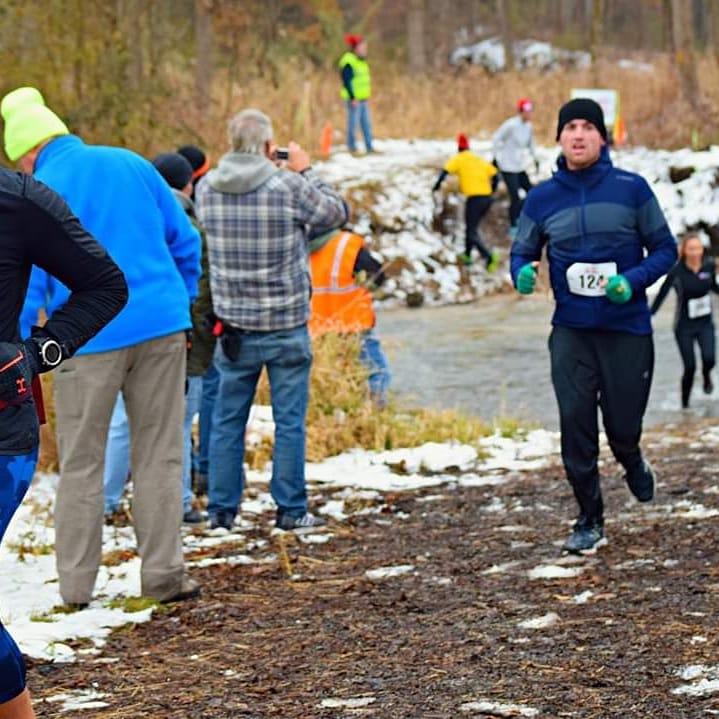
On November 17th, I arrived at a forest preserve in Elgin, Illinois, for the inaugural Big Timber Cross Country Challenge, an 8K put on by Dick Pond Athletics. It was 30 degrees, and I had no clue what I had signed up for.
I can remember being told to look before I leap when I was younger, but I can also remember thinking, “Nuts to that.” As a result, I can be recklessly impulsive, and it has worked out for me more often that not. So when I saw that there was an 8K taking place less than five miles from my apartment, I did not hesitate to sign up, and dupe a friend into doing so as well.
Before the race, the organizer explained the course to us. It would be hilly and a bit rugged, there was also a creek crossing. Finally, this was not a chip-timed race. Everyone would line up at the starting line, and funnel into a single line, more or less, for the remainder of the race.
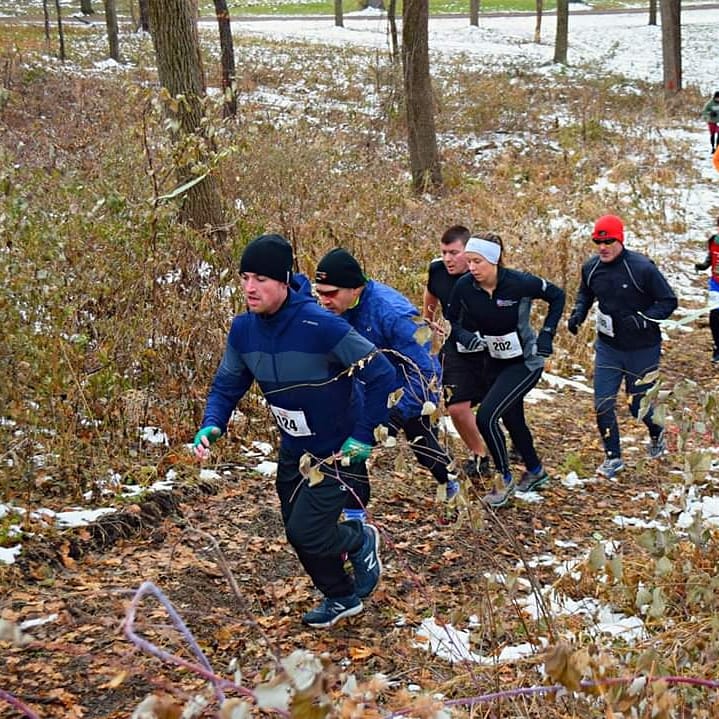
It quickly became evident that this would be a battle of attrition. It had snowed the night before, and the paths were either icy or muddy. Runners were wiping out left and right. Less than a mile in, I was passing runners who opted to walk rather than risk biffing it.
Me Leading a Pack
As I made my way through the first lap of the winding course, hurdling or vaulting over felled trees, I eventually reached a little stream that had a cinder block in the middle that acted as a stepping stone. A volunteer shouted, “Be careful on the block.” It was very unstable. Nevertheless, I made it across, unabated. I then wondered to myself if that was the creek crossing about which the organizer had warned us. A small sign on the side of the trail read, “That was not the creek.”
Less than half a mile later, I saw people climbing to the top of a hill and coming to a complete stop. Upon reaching the top myself, I understood why. The creek was about 10 meters wide, and the water was moving at a pretty good clip. I was about halfway through when I realized that the creek was much deeper than I expected (about knee-deep) and that I still had nearly 3 miles left to run, in soaking sweats and shoes. I feared that I would never feel warm again.
Realizing that my legs would be cold for the next hour or so.
I finished the race without falling, rolling an ankle, or drowning, so even though my time was not as good as I had hoped, I considered the race a success.
I apologized to my friend, who had finished minutes before me, telling him I must not have read the fine print about the river. Upon getting home, I reread the race description, only to find that the water hazard was not in the fine print — it was in the large print.
¹ Thanks to The Lost Girls Podcast (@TheLostGirlsTX) for helping me identify a cult when I see one.
² You might be thinking, “But Tom, what about Phish?” Yes, they do have a cult following, and yes, I have spent multiple summers following them around the country. Still, I would hardly consider lyrics like “Bag it, tag it, sell it to the butcher in the store” to be scripture, and I regularly criticize that cult’s leader.
A Note From The Author: Up to this point, I have tried to keep the main thread of this blog chronologically linear while keeping each chapter focused on one particular activity. This format is not great for demonstrating that many of these activities were happening concurrently but is better when trying to keep each chapter of a serialized story self-contained. This chapter does not follow that format. This chapter is that episode of your favorite TV show that does not quite jibe with the format of the rest of the series (Breaking Bad: The Fly; Twin Peaks The Return: Episode 8), the one song on your favorite album that was written by the weird guy in the band (Sgt Pepper’s: Within You Without You; American Beauty: Operator), or the chapter of your favorite novel that reads as though the writer was on acid for just that one chapter. This chapter is The Piper At The Gates of Dawn.
It is 2009, I am in the apartment, above the bike shop, in Normal, Illinois, that I shared with three friends. One of my roommates yells, “Let’s stretch!” and we all sit on the floor stretching. It is weird, but it happens.
It is 2013, sometime between midnight and 2 a.m., and I am in my apartment in Palatine, Illinois. An On-Demand yoga for runners instructional video plays on the TV in my living room. A few months from now, I will aggravate an old injury and will use this as an excuse to go years without working out again.
It is October 24, 2014. I am at Venice Beach, and a large group of yogis are practicing in the grass, only a few hundred feet from the ocean. I walk past and think, “I wish I could do that.”
It is July 27, 2018. I am in the upper ring of The Forum in Inglewood, California, waiting for Phish to take the stage with my friend Sean. I comment on how much weight he has lost. He says he was running and doing yoga. This is the first time I hear a man talk about practicing yoga.
Shortly after I started riding my bike regularly, I went to the store and bought the most economical yoga mat and yoga for beginners DVD that I could find, and I committed myself to practicing twice a week. I have probably worked out to this video 100 times. So my first year of yoga only ran me about $13 in total.
It is not “Certified Fresh” but I do recommend it to those looking to test the waters
At first, it was incredibly difficult. After only a few seconds of plank position, my entire body would shake. In Warrior II, I had difficulty keeping my arms parallel to the ground for very long, and my quads would beg me to stop. In Reclining Pigeon Pose, I was not able to clasp my hands behind my thighs. In Tree Pose… I was not able to do Tree Pose.
With a year of practice and a considerable decrease in weight and circumference, I showed incremental improvement, eventually being able to clasp my hands behind my thighs. Tree pose is still very challenging, but now there are occasionally days when my balance is fantastic.
As I stated in Chapter Four, in September of 2019, I was feeling isolated, and when I told my therapist this, he suggested that I take yoga classes, because it would get me out of my house, interacting with people who were of my ilk. (This guy loves suggesting that I take classes. A few years back, he got me to take a bluegrass guitar class. In retrospect, this was ridiculous, but now I can play Old Home Place on the guitar, so…)
In early October of 2019, I signed up for a yoga series called “Raw Beginner” at Sama Yoga in West Dundee, and the second I met the instructor, I knew I was in the right place.
Sama Yoga in West Dundee, Illinois
He was a rather jovial middle-aged man, who (like me) had lost a considerable amount of weight, and whose enthusiasm was infectious.
The first class of the series consisted mostly of concepts and poses that I had learned from my beginner-level yoga DVD, but it did introduce me to Cat / Cow Poses. I find the DVD’s omission of these to be odd, as they were one of the first things taught, and nearly every class I have attended since has started with these.
All the classes after the first one consisted almost entirely of poses that I had never attempted.
One Thursday night in November, I showed up to what Sama’s online calendar billed as a meditation class that was to be led by a Buddhist monk. Upon entering the studio, I was “greeted” by a large dog. I love dogs, so I immediately attempt to pet this giant dog, but he was not too keen on me and started growling. This got the attention of the dog’s owner/owner of the studio (Kim), who told me that Ollie does not like men who haven’t given him treats. So she gave me a handful of dog treats, and now Ollie and I are best friends. I signed up for a month membership then and there. Hanging out with the dog is worth the price of membership — but I digress.
A couple of handsome boys
That night, there was only one other person who attended class. At the beginning of the class, Kim that we would need two blankets, a strap, and two bolsters. She then proceeded to turn off all of the lights. I had never meditated before, so none of this raised any red flags. After Kim guided us through some gentle yoga moves for a few minutes, and the monk had not yet shown up, I started wondering what was going on and honestly thought that she was an “opening act” and that he (a Buddhist monk) would come out after the crowd was warmed up — for meditation.
After half an hour of incredibly gentle yoga, I started to think, “I don’t think this is a meditation class at all.” Fifteen minutes later, the only other person in this class (an elderly man, also named Tom) had fallen asleep and was snoring. The sound of him snoring, coupled with me concluding that I was not in a meditation class, but was actually in a geriatric¹ class, gave me a sudden and severe case of the giggles.
As I left, Kim asked if she would see me the following week, and I said, “Maybe,” but was thinking, “No way in hell.”
I went home to check to see if the calendar was wrong or if I was wrong. It was the calendar. Upon waking up the next morning, I felt better than I had in months, so I went back the following week.
In December, I finished the Raw Beginners course, started taking all-levels classes, and upgraded my mat from the cheapest mat on Earth, to one that meets my specific needs (I sweat like you would not believe, so a mat that prevents slipping is important).
So far, the only thing I have not seen incremental improvement in is final savasana, a period of meditation/reflection while lying in a supine position. My mind does not do well with silence or reflection.
Whenever people ask for advice on how to lose weight, my best advice is always, find a physical activity you will not dread.² So far, that has been yoga for me. I look forward to it every week. It was for this reason that I gave my parents my old beginner-level yoga DVD, and I signed them up for the Raw Beginner course as a gift. I truly believe practicing yoga can be a life-changing thing.
¹ The next week, when I was registering, I found out that it was not a geriatric class, but a restorative class. ² I have to bite my tongue because my initial thought is always to ask if that person likes him/herself, and to tell that person to stop if he or she does. It is remarkably easy to change yourself when you hate yourself.
My first month or so running was not particularly eventful, funny, or even interesting. I started on the treadmill three days per week, running a quarter-mile, then walking a half-mile, and over the course of a few weeks, I increased my running distance to one mile while decreasing my walking distance to a quarter-mile. From there, I moved to the indoor track, which somehow managed to be less exciting and more tedious than the treadmill. Once again, incrementally increasing the distance by 10% a week.
For anyone who has never run long distances and intends to, here is my best advice: There are certain jobs which should only be done by professionals. Jobs like surgery, bridge design, bomb defusing, and running shoe selection. For this, I went to Dick Ponds in Hoffman Estates.
The shoe fitting process is not entirely unlike the wand selection process from Harry Potter. You get on a treadmill, and they analyze your gait and select a shoe based on your running style. (Just like Harry Potter.) The first shoe they chose for me was the New Balance 860v9. I would max these shoes out at 300 miles, and they are still my crappy weather shoes. I loved them.
As I mentioned in Chapter Two, I had signed up for a 5k (The Dublindee 5k in East Dundee, Illinois), and had two months to train for it. My original goal was to run the entire 3.1 miles in under 27 minutes, but it was a week before the race, and I had not yet cracked 29 minutes. I tempered my expectations and changed my goal to 29 minutes, so a failure to meet expectations would not defeat me.
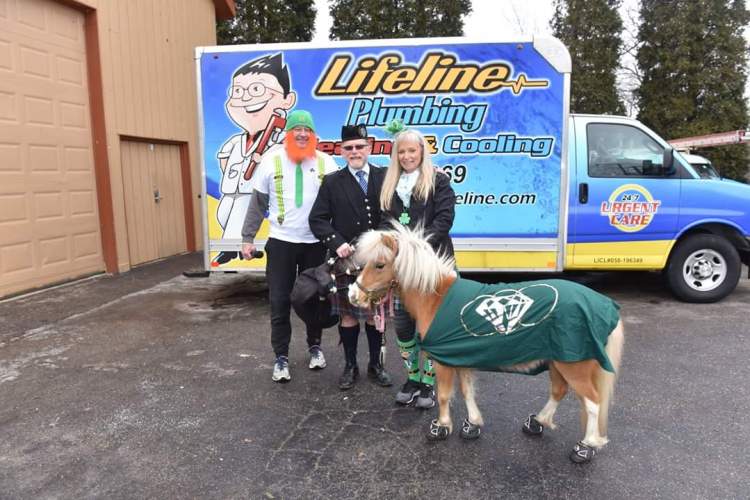
As Joseph Campbell would tell you, every hero’s journey requires a villain, and my villain was waiting for me in Lifeline Plumbing and Heating. As I stretched in the warmth of Lifeline’s garage (the starting point of the Dublindee 5k), I overheard a fellow fun runner talking about how she was worried that she might not finish the race. I was not the only person outside her party to hear her, as a middle-aged man replied to her in an admonishing tone, “If you can’t just wake up and run a 5k, you’re in pretty sad shape.” She was stunned; I was stunned; we were all stunned.
Upon hearing this, my goal was no longer to finish in 29 minutes. My goal was to beat that man.
He started about 10 yards in front of me, but I had passed him within the first quarter-mile, and did not see him again until I was on the “back” half of the “out and back.” I had a substantial lead on him. I crossed the finish line with a time of 26:04. I had crushed my original goal, which I deemed to be unrealistic, by 54 seconds. Unfortunately, I did not see how much I beat my villain by, because I was distracted by a miniature horse.
I Defy You To Not Be Distracted By This Tiny Horse
My runs grew longer and got faster. My Dublindee 5k pace eventually became my long slow distance pace, and my race pace teetered around 7-minute miles.
Every couple of weeks, I would participate in a different 5k.
Dublindee Kilted 5k: 26.04
Deer Park St Paddy’s 5k: I don’t remember my time, but this would be my last race over 200 lbs.
Marklund Run, Rock, and Roll (Bloomingdale):??? / 2nd in age group
Race To Zero (Libertyville): 24:49
April Fools 5k (Bloomingdale): 24:27
Hops For Hope Beer Run (St. Charles) 24:22¹
Mother’s Day 5k (Barrington): 23:10
Glo Run (Hoffman Estates): 22:56; 8th overall / 1st in age group
Lions Heritage (Dundee): 22:13 (This is still my “Old Man” Personal Record. My actual PR is 20:20 which I achieved when I was 15)
I Take Comfort In Knowing That I Ruined This Picture For Another Runner
By the end of the summer, I weighed 170 lbs, which was the weight that I was hoping to achieve and maintain. This is a net loss of 110 lbs. I was healthier than I had been in over a decade, but something was wrong.
“Cathy, I’m lost […] I’m empty and aching, and I don’t know why.”
Paul Simon, America
I was 16 years old when I realized something was wrong with me. I was almost always sad, but I was able to rationalize this sadness by citing two serious life events (SLEs) that occurred in the latter half of 2003. An entire lifetime later, these events would hardly be considered SLEs, but to a 16-year-old, they were reality shaking.
Unfortunately, as time wore on, this sadness only got worse. I did not want to participate in social events because I had developed the belief that my classmates, friends, family, and society as a whole disliked me, despite all evidence being to the contrary.
One night my mom told me that she had scheduled an appointment for me, to which I replied, “For a psychiatrist?!”
The appointment was for a haircut. I played it off as a joke, but even then (at 16 years old), I knew that I needed help.
I was expending all of my energy by pretending that nothing was wrong, but a person can only do that for so long. In November, I could no longer put on a brave face. Remember that haircut from literally four sentences ago? Well, that turned out to be the straw that broke the camels back. As my mom drove me home from the haircut, I broke down.
I remember sitting at the dinner table, visibly distressed, and my parents asking what was wrong. I had no clue what was wrong with me. As tensions around the table grew (they were under the impression that I was in trouble; to be fair, I was always in trouble), I had to make up some plausible bullshit to placate them. I mentioned the SLEs (from which I was now several months removed) and how my haircut symbolized loss of control. In retrospect, the six years that followed this conversation would have probably been better had I stuck with, “I don’t know what is wrong with me.”
It was during this time that the compulsive behavior that I detailed in the prologue was at its most self-destructive.
In the spring of 2010, I moved back in with my parents, and for only the second time since high school, I went to the doctor. After the nurse checked my blood pressure, pulse, and temperature, she asked me if I ever felt hopeless. I “joked” that I had not felt hopeful since 2003. After a few additional visits and blood tests, I was diagnosed with Major Depressive Disorder (MDD), and things immediately got better for me.
In May of 2019, I went back to the doctor under the guise of knee pain, knowing that they would have to give me another depression screening. When the nurse asked if I ever felt hopeless, I told her in no uncertain terms, “Yes. I feel like nothing I do matters, that I am all alone, and that I am just a bag in the wind being pushed around by forces outside of my control.”
To which the nurse responded, “Oh, ‘a bag in the wind.’ I like that. I’m writing that down.” And once again, things got better, but only for a very short while.
In July, I flew to Portland to visit friends, and I remember saying, “This is the happiest I’ve been in over a decade.” This statement was not hyperbole in any way. If anything, it was an understatement, because this is the truth: I had not felt contentment since either early 2003 or late 2002.
A week later, I saw three nights of Phish, including one of the best concerts I’ve ever attended, and a week after that, I ran a 5k and won my age group for the first time in my life. During these few weeks, I was on record saying, “I feel like I am living someone else’s life.”
These were my salad days.
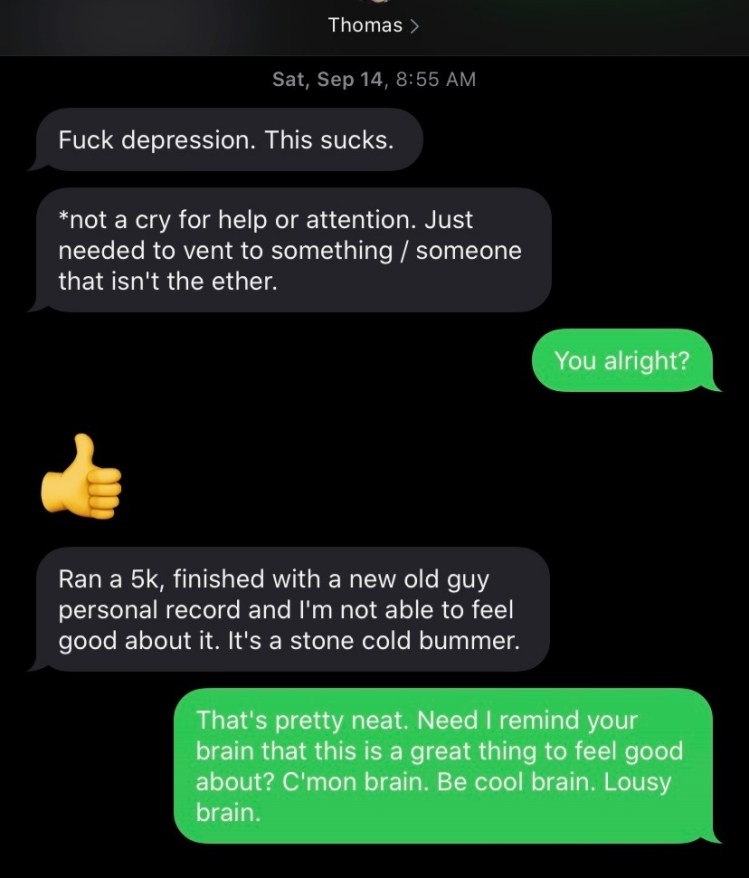
On September 14th, I, once again, realized that something was wrong. I had just finished my last 5k of “the season” and finished with a time of 22:13. This time was a whole four minutes faster than that of my first race of the year, but I felt no sense of accomplishment and nothing that resembled happiness. At the award ceremony, I had the following text conversation with a friend.
My Buddy Blaine Has Been On The Business End Of Hundreds Of Similar Texts And Phone Calls
So I went back to my doctor, therapist, and psychiatrist and was diagnosed with something that I had never heard of: Persistent Depressive Disorder (formerly Dysthymia). This new diagnosis did not replace my previous diagnosis of MDD; they are in tandem. This unholy alliance is called “Double Depression,” and it is just a ton of fun. My mental health team then changed my medication, and things got so much worse.
I have always told myself that I am smart enough and strong enough to handle my mental health issues on my own, so I did not keep my friends or family informed about the state of my mental health nor the steps I was taking to get better. This, in retrospect, was dumb.
On the evening of Friday, November 1st, I woke up from what I would describe as an “involuntary floor nap.” It was then that I realized that I needed help badly, so I reached out to three friends with the innocuous text message, “Do you have time to talk?”
After what seemed like an eternity, but was only 15 minutes, my friend Sean called me and listened as I told him I was speaking to him from the gates of hell. He provided a comforting, rational voice, and stayed on the phone with me until he was sure I was not in danger, and that I had my next steps figured out.
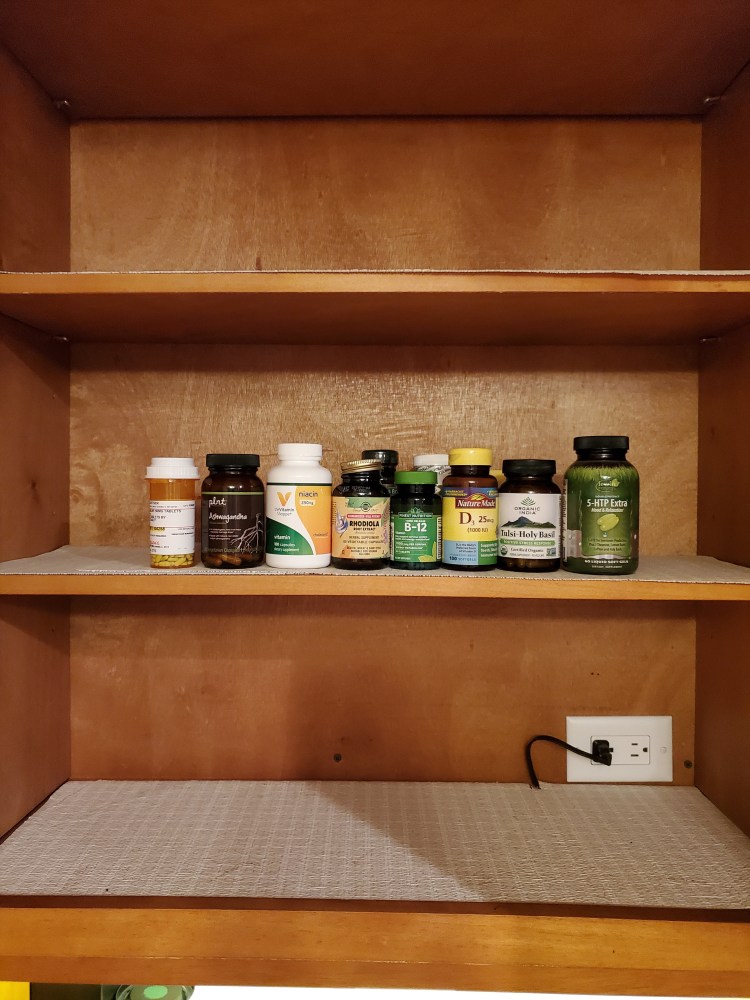
After this episode, I realized that U2 was correct– sometimes you can’t make it on your own. As a result, I made five people to whom I would feel comfortable reaching out, aware of what had happened, and that I needed a plan should there be a next time. This plan included a pretty damn formal document that helps my five-person mental health support team know how to help me when I am in crisis, and a whole mess of holistic remedies that may or may not be snake oil. These remedies include:
5-HTP
Ashwagandha
B12
D3
Niacin
Rhodiola
Tulsi-Holy Basil
I Have Too Much Cabinet Space
Additionally, I read Unfuck Your Brain, This is Your Brain on Depression, and How Not To Kill Yourself. Three exceptional, and short, books on depression and recovery. I recommend all three to anyone who is struggling with depression.
As of writing this, I am still not back to “normal,” some days are very challenging. Still, I am determined to get there, and now that I am not facing this alone, I am confident that I will get there.
Late one evening in the fall of 2007, my friend Alex and I arrived via cab at the dormitory in which another friend named Alex lived, on the Illinois Institute of Technology’s campus, on the South Side of Chicago. Having just been kicked out of Second City, Alex and I were in high spirits and were looking for a fight. Rather than bringing a third party and potentially the police into our violent little shenanigans, I thought it would be a good idea to fight each other.
We stood toe-to-toe in the middle of our friend’s cramped dorm room, and when he said, “go!” Alex did not hesitate to unload a right cross to the side of my face. This blow was the first one to ring my bell truly. If I had to guess, I hit the ground, but I honestly do not remember. What I do remember is that Alex felt like he might have jumped the gun and accidentally sucker punched me. I cannot remember whether he had or not, so he offered me one free shot, after which the fight would resume. Having never thrown a punch in earnest, I was unaware that there was such thing as correct form, so I took my best shot in the way that felt the most natural, which unfortunately included tucking my thumb into my fist. I can only make an assumption here, but I most likely inflicted more pain on myself than I did on him, because I broke my thumb, and he barely even staggered.
Realizing that something had gone disastrously wrong, but wanting to continue the fight, I changed tactics and opted to take Alex to the ground. We spilled into the hallway and, eventually, the dorm room of some unsuspecting strangers. The fight was broken up, but not before our bloodlust was satiated. Years later, I stood up in my opponent’s wedding. We are still close friends. It would be years before I threw another punch.
In January of 2019, I was feeling the full effects of gym fatigue, and as I said in Chapter Two, my hitherto iron will was starting to buckle. I was in desperate need of a change of scenery, and as a man who has seen all the good Rocky movies at least twice¹, I knew what I wanted to do. In mid-February, I called Pro Boxing Fitness to set up a trial class.
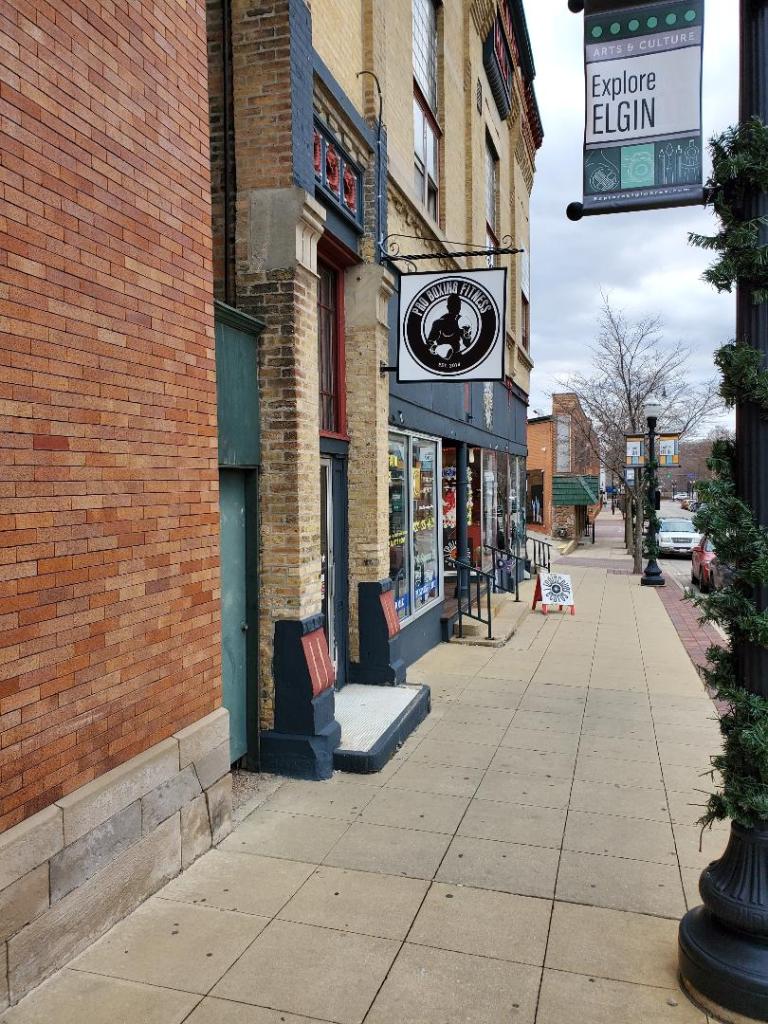
Located kitty-corner from my favorite coffee shop in Elgin (Blue Box Cafe), and above a record store that I frequent (Rediscover Records), Pro Boxing Fitness’s location was nearly ideal. It also did not hurt that the entire place gave off strong Rocky vibes.
Pro Boxing Fitness in Downtown Elgin
Before I agreed to attend the trial class, I probably should have asked a few more questions because all I asked was, “What should I bring?” To which I was told to wear comfortable clothes and to bring an ID. What I should have asked was, “What is the mean age for the 5:30 class?” Because when I got there, a throng of skinny teens and preteens in boxing gloves greeted me, which gave me pause.
The class started with some light warm-up cardio, such as jumping jacks, jogging in an absurdly tight circle whilst shadowboxing, and, regretfully, jumping rope. I say “regretfully” because I have the coordination of a newborn giraffe. There was no point during this first class that I was able to make four consecutive successful jumps, and what made it even more undignified was that the instructor would have the class change jumping styles every 10 seconds.
After I had thoroughly humiliated myself attempting to jump over a rope, the instructor had me slide my hands into disgusting old loaner gloves, and took me into the ring as the children shadowboxed. During this one on one breakout session, he taught me how to stand, and the basic moves of boxing: jab, cross, hooks, uppercuts, slips, ducks, and blocks, heaping praise on my ability to learn all the while.
After the instructor had inflated my ego and was confident that I would be able to follow instructions, we rejoined the tykes, who had been left unsupervised for too long. It was now time to spar.
At this point, all the younglings paired up with their friends, leaving me without a partner, to which I thought, “Cool, I’ll probably get to spar with the instructor.” But that is not what happened. The instructor told one child that he would be sparring with him, and that child’s previous partner, also a child, would be sparring with me.
I, who was 31 years old and 210 lbs, stood toe-to-toe with an infant in boxing gloves, as the instructor shouted out the combinations he expected us to execute. I took it slow, really slow, as I telegraphed each punch, intentionally jabbing short and hooking high. After a few rounds, the itty bitty baby human told me that I could earnestly swing at him, to which I replied, “No, I really can’t.”
After that, we took our gloves off and did crunches and other abdominal exercises. This concluded my first class.
The following day, I received a call from the owner, asking how I enjoyed my first class, and I gave him my honest assessment. It was fun, and it was a good workout, but I was not comfortable throwing punches at toddlers. He then informed me that the 6:30 class was predominately adults and offered to give me an additional trial in the different timeslot. I went back a few days later, and at the conclusion of this second trial, I signed up². I committed myself to attending three classes per week, and I continued to go to the Rakow Center on the days that I did not box.
Every class started the same way, with me embarrassing myself by attempting to jump rope, then sparring at a snail’s pace, and ending with crunches, and this routine accelerated the rate at which I was losing weight. It was great, but after a while, my hand started hurting from all the punching. I had to stuff a sock in my glove to give me some additional padding and ice my swollen hand after each class.
Then there was the crazy Russian.
I do not remember his name, but he was every bit 6′ 4″, and he was a force of nature. He would show up early and work the heavy bags, he would jump rope nearly twice as fast as anyone else, and when he sparred, he did not put up his hands to block, nor did he pull his punches. Each sparring session with this guy felt like a fight to the death. He would not execute the instructor’s combinations. Instead, he would improvise, so my slips, ducks, and blocks were all reacting to his hail of blows, rather than executing the scripted defensive moves. He would try to goad me into boxing matches, but I knew he would dismantle me if I strayed from the scrip, so I never once did. After a few rounds with this man, I realized that he would not hesitate to break my glasses with a cross to the face, so I took my glasses off and sparred with him half-blind. This went on for three months.
Overall, I truly enjoyed my time at Pro Boxing Fitness. However, between the nagging injuries, the children with whom I still had to share a locker room, and the crazy Russian, I knew that it was going to be a temporary membership. As soon as the weather started getting nice enough to workout outside nearly every day, I canceled my membership.
¹ Rocky, Rocky II, Rocky IV, Creed, Creed II ² $110/month (for 3 months) + $75 for gloves and wrap. Boxing Total = $405.